
AI assisted editorial. Published following automated quality checks, not independent fact verification. Confirm factual, safety and legal matters with appropriate professionals.
The short answer
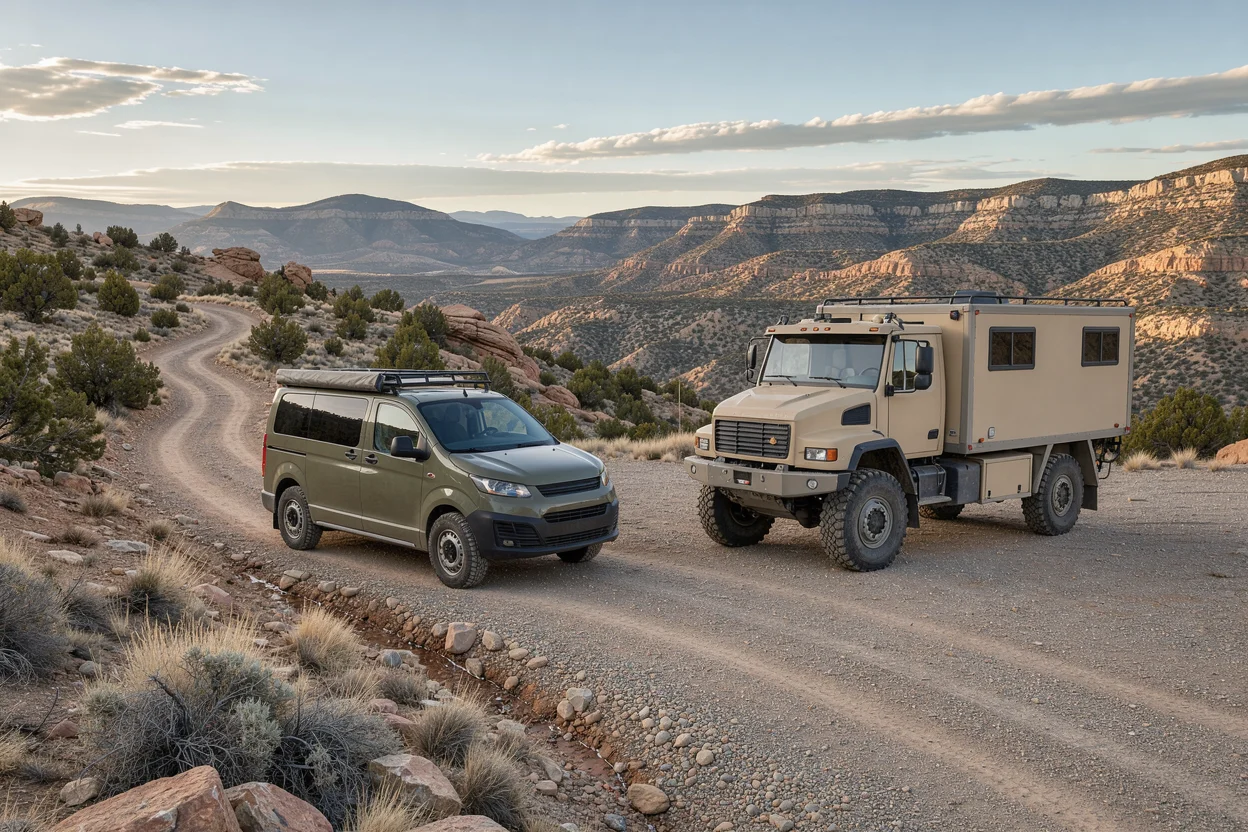
Selecting between a four wheel drive van and an expedition truck comes down to balancing agility against payload and habitat volume. Vans offer nimble handling, standard driving licencing, and easier urban transit, whereas purpose built trucks deliver immense carrying capacity, extreme durability, and superior off grid independence at the cost of manoeuvrability and accessibility.
Key takeaways
- Weight margins dictate longevity: vans often flirt with legal gross weight limits once converted, while trucks handle substantial payloads comfortably.
- Physical footprint directly shapes your itinerary, as height, width, and track limit access to narrow trails, mountain passes, and urban centres.
- Mechanical accessibility and parts sourcing vary wildly; commercial vans enjoy widespread local workshops, while heavy chassis require specialist commercial facilities.
- Licence and regulatory classifications must be resolved early, particularly regarding gross vehicle weight thresholds and regional driving restrictions.
Core Philosophy: Agile Mobility versus Sustained Endurance
Prospective overland travellers frequently find themselves weighing the virtues of a factory or aftermarket four wheel drive van against the imposing capabilities of a dedicated expedition truck. While both platforms promise freedom beyond paved roads, they approach remote travel from fundamentally distinct engineering philosophies.
A four wheel drive van is conceived primarily as a light commercial utility vehicle adapted for mixed surface mobility. It maintains a unified body shell, relatively compact proportions, and car like ergonomics. This design prioritises road travel manners, fuel efficiency, and access to constrained spaces such as historic towns, tight forest tracks, and coastal car parks. The compromise lies in its restricted internal volume and rigid weight limitations.
Conversely, an expedition truck is typically built upon a medium- or heavy duty commercial or municipal truck chassis, carrying a completely decoupled, torsion isolated living module. Its engineering priorities centre around brutal structural resilience, deep wheel articulation, expansive water and energy storage, and generous payload capacity. However, these benefits demand acceptance of substantial road presence, slower cruising speeds, and severe physical access limitations.
Physical Footprint, Terrain Access, and Driver Ergonomics
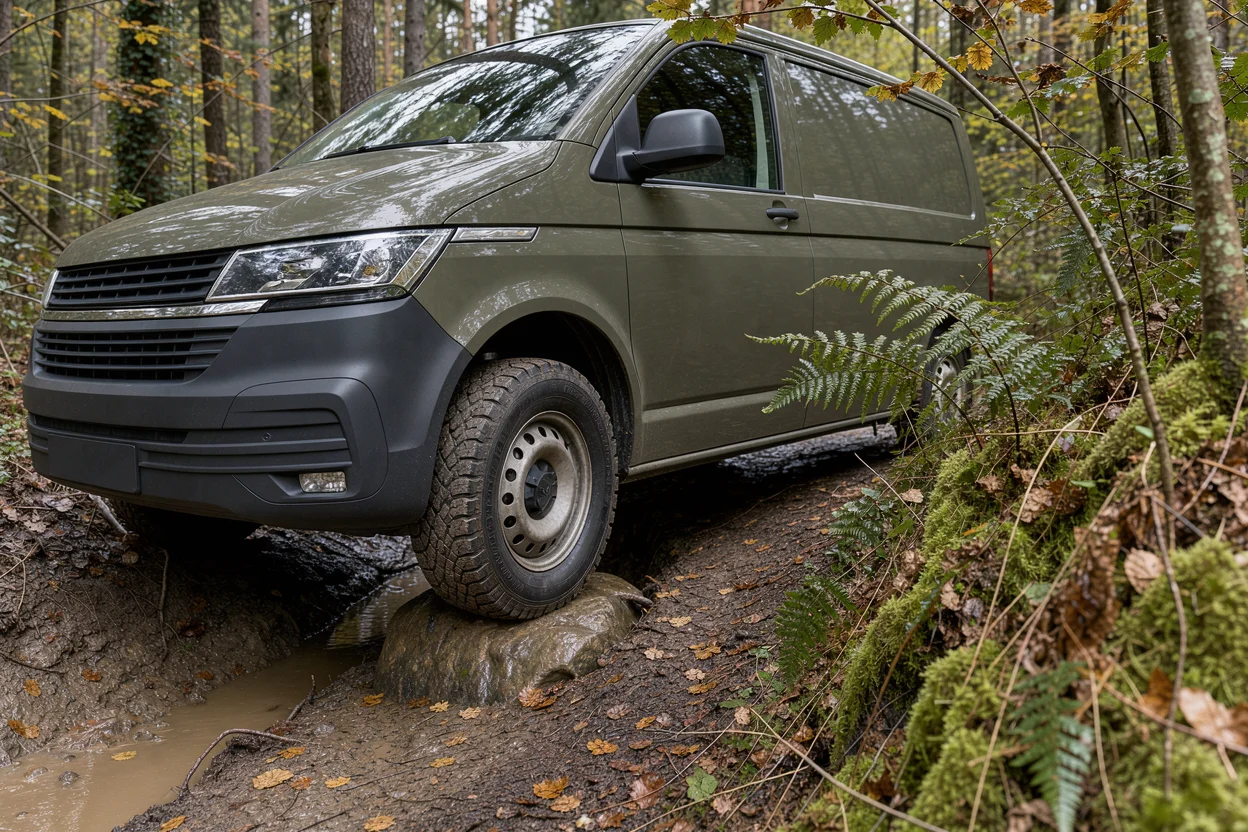
Dimensions dictate where a journey can physically take you. A four wheel drive van usually maintains a manageable width and a moderate height. This narrow profile allows drivers to negotiate dense vegetation, tight switchbacks, low bridges, and standard shipping containers without constant stress. Furthermore, a van feels familiar to pilot, requiring minimal adjustment for drivers accustomed to standard passenger vehicles.
Expedition trucks present an entirely different operational envelope. Their significant width and height rule out many forestry tracks, sunken rural lanes, and low hanging bridge underpasses. Tree strikes can cause costly damage to composite habitat boxes, roof mounted solar arrays, and recovery equipment.
On unpaved surfaces, however, the truck's greater ground clearance, larger wheel diameters, and robust running gear allow it to roll over severe washouts, boulders, and deep ruts that would easily bottom out a laden van. The driver must weigh whether their typical route includes tight tracks or vast open terrain where physical size poses minimal friction.
The Practical Comparison Framework
To objectively assess each vehicle type, evaluate your intended travel style across four foundational criteria: Weight and Payload Integrity, Habitation and Self Sufficiency, Serviceability and Recovery, and Legal and Regulatory Impact.
Weight and Payload Integrity: A van's conversion frequently pushes it close to its gross vehicle weight rating, leaving limited spare allowance for additional water, fuel, gear, and spare parts. A truck provides ample headroom, ensuring heavy equipment and large fluid reservoirs do not strain the chassis or exceed legal axle limits.
Habitation and Self Sufficiency: Expedition boxes offer full height, squared internal walls, advanced insulation, and extensive battery banks, allowing months of independent stationary living in extreme weather. Vans require thoughtful, multi use furniture compromises and have limited thermal barriers due to factory window apertures and structural metal ribs.
Serviceability and Recovery: Light vans can be repaired by standard automotive garages across most continents. Recovering a stuck van requires typical winches and ground anchors. Trucks require heavy plant workshops, specialized tyre changing equipment, and recovery gear rated for commercial machinery.
Legal and Regulatory Impact: Standard driving licences often permit driving vans up to typical light commercial weight thresholds. Exceeding those thresholds moves the vehicle into heavy goods classifications, triggering requirements for professional driving licences, periodic vehicle inspections, speed limiters, or professional driver tachographs depending on national legislation.
Maintenance Complexity and Long Term Operating Realities
Owning an overland platform involves substantial ongoing administration and upkeep. Light commercial vans benefit from ubiquitous component availability, standard replacement tyres, and universal availability of roadside recovery memberships. Running costs, toll charges, and sea freight rates also stay relatively moderate when shipping via roll on/roll off or standard sea containers.
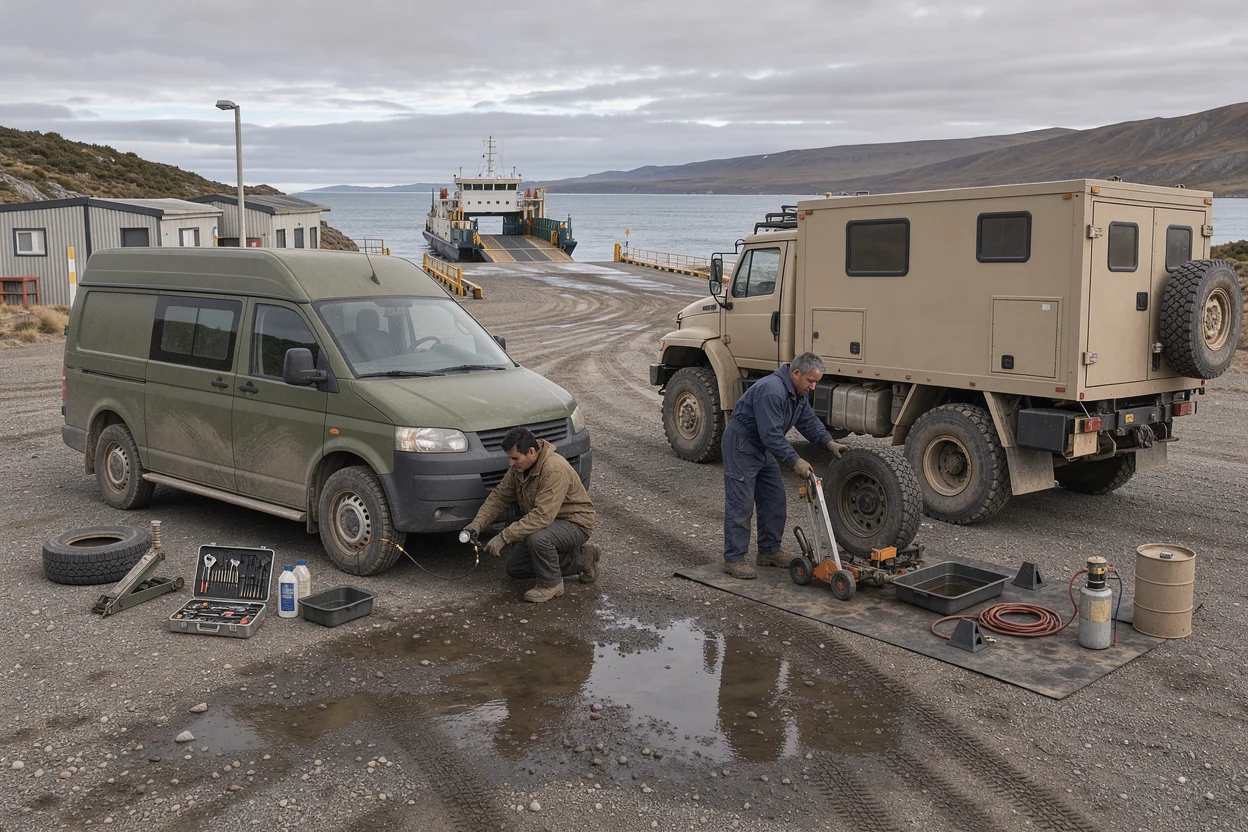
Expedition trucks demand an industrial maintenance mindset. Basic fluid changes require significantly larger oil capacities, pneumatic brake systems need specialized moisture management, and tyres require heavy mechanical lifting aids to replace safely. Additionally, toll roads, bridge crossings, and international ferry transport charge steep commercial surcharges based on total vehicle weight, length, and height.
Fuel quality sensitivity is another crucial factor. Modern light commercial vans feature delicate emissions equipment that necessitates ultra low sulphur diesel and auxiliary exhaust fluids, creating genuine challenges in regions where fuel quality varies. Older or heavy duty commercial truck platforms may tolerate lower fuel standards better, though this varies considerably by engine generation and market specification.
Vetting the Vehicle: Essential Questions to Ask Sellers
Whether purchasing an existing build or a rolling chassis, obtaining precise facts from the seller avoids costly surprises. When inspecting a four wheel drive van, ask: What is the certified weighbridge weight in full travelling trim with full tanks and passengers? Has the suspension or braking system been certified for gross vehicle weight upgrades? How has thermal bridging behind internal wall claddings been mitigated?
When evaluating an expedition truck, direct your enquiries toward subframe engineering and chassis history: What specific subframe isolation system is used to detach chassis torsional twist from the composite habitat box? What is the vehicle's registered unladen and maximum permissible gross weight on registration documents? What commercial driving licence class is legally required to operate this vehicle on public roads? How old are the chassis air brake components, pneumatic valves, and wheel hub seals?
Hypothetical Decision Example: Two Distinct Overland Profiles
Consider a hypothetical couple planning a multi year itinerary split between European mountain passes, narrow coastal roads, and occasional gravel tracks. They place a high priority on entering village centres, parking in ordinary bays, and keeping administrative logistics simple. For this scenario, a four wheel drive van is the pragmatic choice. The compact dimensions prevent constant route diversions, while the moderate living space remains perfectly adequate for their mobile, outdoor oriented habits.
In contrast, consider a hypothetical travelling party aiming to spend uninterrupted months traversing expansive, remote desert tracks and Arctic tundra with minimal infrastructure. They carry several weeks of water, comprehensive recovery apparatus, and heavy communications equipment, requiring an interior that functions as a self contained home during prolonged sub zero blizzards. In this scenario, an expedition truck is the logical platform, as its immense payload, subframe durability, and expansive habitat outweigh any inconveniences associated with bulk or urban restricted zones.
Common questions
Can I drive an expedition truck on a standard car driving licence?
This depends entirely on the vehicle's registered gross vehicle weight and your local licensing regulations. In the UK and Europe, standard car licences only cover vehicles up to 3,500 kg unless grandfather rights apply. Most true expedition trucks exceed this threshold and require a commercial driving licence.
Are 4x4 vans capable enough for true off road overland routes?
Yes, provided the terrain matches their clearance and geometry. Four wheel drive vans handle dirt roads, moderate mud, sand, and corrugated surfaces well. However, they lack the extreme wheel travel, ground clearance, and massive tyre rolling diameters found on dedicated trucks, limiting them on deep washouts or rocky trails.
How do shipping costs compare between vans and expedition trucks?
Vans are generally much cheaper to ship internationally because many can fit inside standard shipping containers or incur lower volume rates on roll on/roll off vessels. Expedition trucks exceed standard container dimensions, requiring flat racks or costly oversized roll on/roll off transport.
Why does chassis torsional twist matter on an expedition truck?
Truck chassis rails flex significantly over uneven terrain to keep wheels planted. If a living habitat is bolted rigidly to this flexing chassis, the torsional forces will tear the habitation box apart. Proper trucks use three point, four point, or diamond pivoting subframes to isolate the living box from chassis twist.